
Telling the difference between a movement, an action and a trade-skill is not that complicated! We explain it all
From the “small movement” to the larger meaning: (re)seeing the Professional Trade-Skill
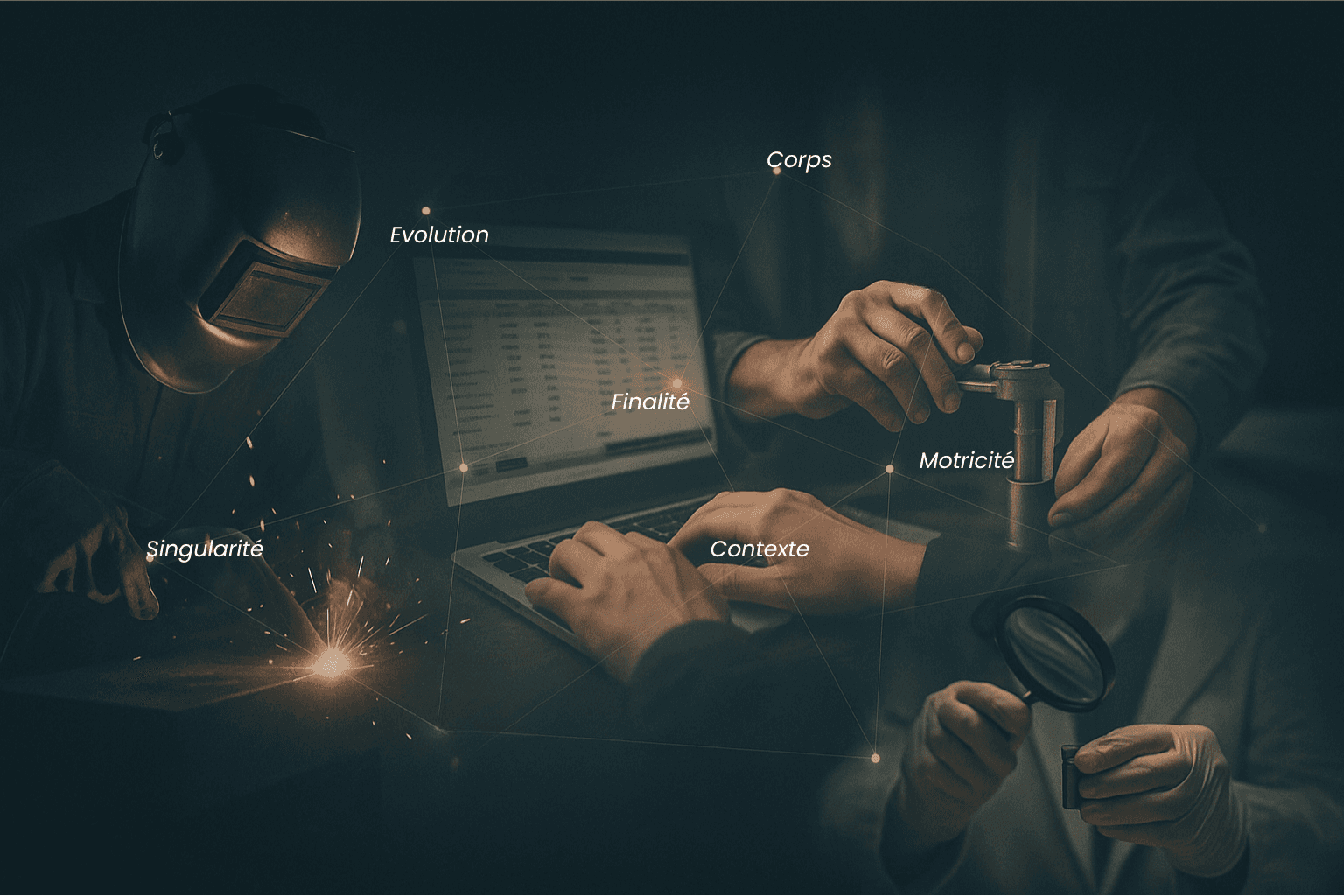
You see Pierre, a seasoned welder, set down his torch as one would unscrew a jar — with a mix of strength, finesse and that micro-pause that says “there, that’s it”. At the other end of the building, Sophie, an accountant, stops her cursor just before validating an entry: she mentally double-checks the wording, projects the year-end audit, almost hears the “click” the chartered accountant will make. Two trades, two worlds… and the same invisible object: the professional trade-skill.
Why talk about trade-skills in 2025?
Let whoever is not drowning under procedures, software and checklists today cast the first stone. In 2025 we measure lead times, scrap rates or the number of corrected entries… but more and more rarely how things are done. And yet that is precisely where quality, safety, reliability and… the pleasure of work well done reside.
Still not convinced? OK, let’s dig.
The professional trade-skill is not just a movement. It can be a physical action, or a purely intellectual one. It is the concentrate of an intention, a context, constraints and embodied knowledge. When you make it visible and understandable, you open the door to training that makes sense, to TMS prevention, to continuous improvement that does not forget the human being, and to more reliable accounting controls without adding ten Excel columns.
Still in doubt? Simply ask yourself this question:
In my company, if a highly experienced person left, what would be missed most: a procedure, or “the why and the how” she does her job?

What is given to the naked eye is not always the most interesting part of a skill!

“Technical” trade-skill vs “professional” trade-skill: two sides of the same coin
Already two different notions? No panic, it is simpler than it looks. To simplify, one contains the other:
- The technical trade-skill describes the dimensions of the action (motor, sensory, cognitive, physiological, spatial, temporal, instrumental, social/organisational, economic/psychic…).
It is the magnifying glass that lets you unpack and understand what the body, the senses, the head and the collective are doing. - The professional trade-skill insists on its characteristics: motor, functional, structuring…
It is the scenario that tells the story, the purpose and the context behind the action.
Keep this image: the technical trade-skill is the “how it works”; the professional trade-skill is the “why and for whom I do this”. One without the other is like setting a machine without knowing what it is for. Not that useful, is it?
A simple definition to keep in mind:

A trade-skill is therefore visible (the movement), invisible (the intention) and situated (the real constraints). Until you have all three, you do not really have the trade-skill.
And understanding that is already more than 50% of the way!

The triptych to remember to understand a professional trade-skill
Transferring a trade-skill: far more than “do as I do”
Historically, there are two main schools:
- Physiological: oriented towards performance and health (postures, repetition, ergonomics).
- Anthropological / professional didactics: oriented towards meaning, adaptation, conceptualisation in action.
In reality, you need to combine imitation, explanation and experimentation.
Quelques principes concrets :
- Adapt to the level: to the beginner, you show the movement; to the experienced person, you explain the logic and the traps.
- Multiply the mediations: videos, simulation, augmented reality, verbalisation during the action, elicitation interview afterwards.
- Lean on the collective: peers, internal forums, practice analyses. Transfer is not only a master–apprentice matter.
Example: when Lucas, a new apprentice welder, missed the same bead three times, his team leader Marc did not merely “show him again” the trade-skill. He pulled out a slow-motion video, moved Lucas’s torch without lighting the flame so he could feel the trajectory, then asked him to describe what he was watching in the weld pool. Three angles of attack, one click.
Move to action: know how to spot and trace the characteristics and dimensions of the trade-skill
We have seen it together: the Professional Trade-Skill is defined by several characteristics. Imagine you had to write a novel: just as you would need a protagonist, places, a plot, … to unpack a Professional Trade-Skill you must know how to spot several items!
Suppose you have decided it is time to better master the skills that make up your company (well done!) and you want to build a reading grid for them in order to spot Pro Trade-Skills.
We have created the important elements of your grid for you. For each item, we propose (with a double example):
- a short definition,
- a concrete question to ask.
The Purpose of the Pro Trade-Skill (goal-oriented)
- Definition : oriented towards a real goal, not just the prescribed task.
- Exemple industriel : I tighten the torque “just enough” to avoid breakage later.
- Exemple compta : I group certain costs so that the audit traces the logic of the budget, not because the chart of accounts requires it.
- Question : “What real problem am I solving with this trade-skill?”
Its Situation (situated)
- Definition : inserted in a precise material, social and temporal context.
- Industrie : in maintenance, reduced access forces you to invent a different grip.
- Compta : at month-end, deadline pressure changes the order of checks.
- Question : “What surrounding constraints change the way I do this?”
Sa composition technique (composite)
- Definition : mixes motor actions, signs, cognitive and emotional regulation.
- Industrie : adjusting the flame while talking to a colleague, watching the screen and listening to the vibration.
- Compta : pointing out an anomaly while answering the phone and watching the deadline.
- Question : « Quels “micro-gestes" invisibles composent mon geste ? »
Its Evolution (evolving)
- Definition : the trade-skill transforms with experience, tools, rules.
- Industrie : new screwdriver = another way of feeling the torque.
- Compta : new ERP = new control reflexes.
- Question : “What has changed in the way I do this in the last 6 months?”
Its operating logic (Motor, functional, structuring)
- Moteur : the bodily movement, the biomechanics.
- Fonctionnel : how the trade-skill answers the function (hold, aim, check, communicate…).
- Structurant : how experience organises action (schemes, operational invariants).
- Question : “If I had to teach it, what would I start with? The movement, the why, or the overall logic?”
And what about tools in all this? A love story (or a misunderstanding)

A tool is not neutral. It becomes an instrument when it is “tamed” by action: that is what is called instrumental genesis.
Screwdriver, ERP, welding jig, Excel macros… Each tool models the trade-skill and vice versa. The more specialised and autonomous the tool, the more efficiency you gain… but you sometimes lose room for manoeuvre.
Something to ponder when you design a procedure or choose software: does the tool fit the real trade-skill?
Going further: a toolbox for managers
Feeling adventurous but your rucksack is still a little too light? Here is what Indiana Jones always considers before being drawn into a new adventure (if his adventures were to trace Professional Trade-Skills) :
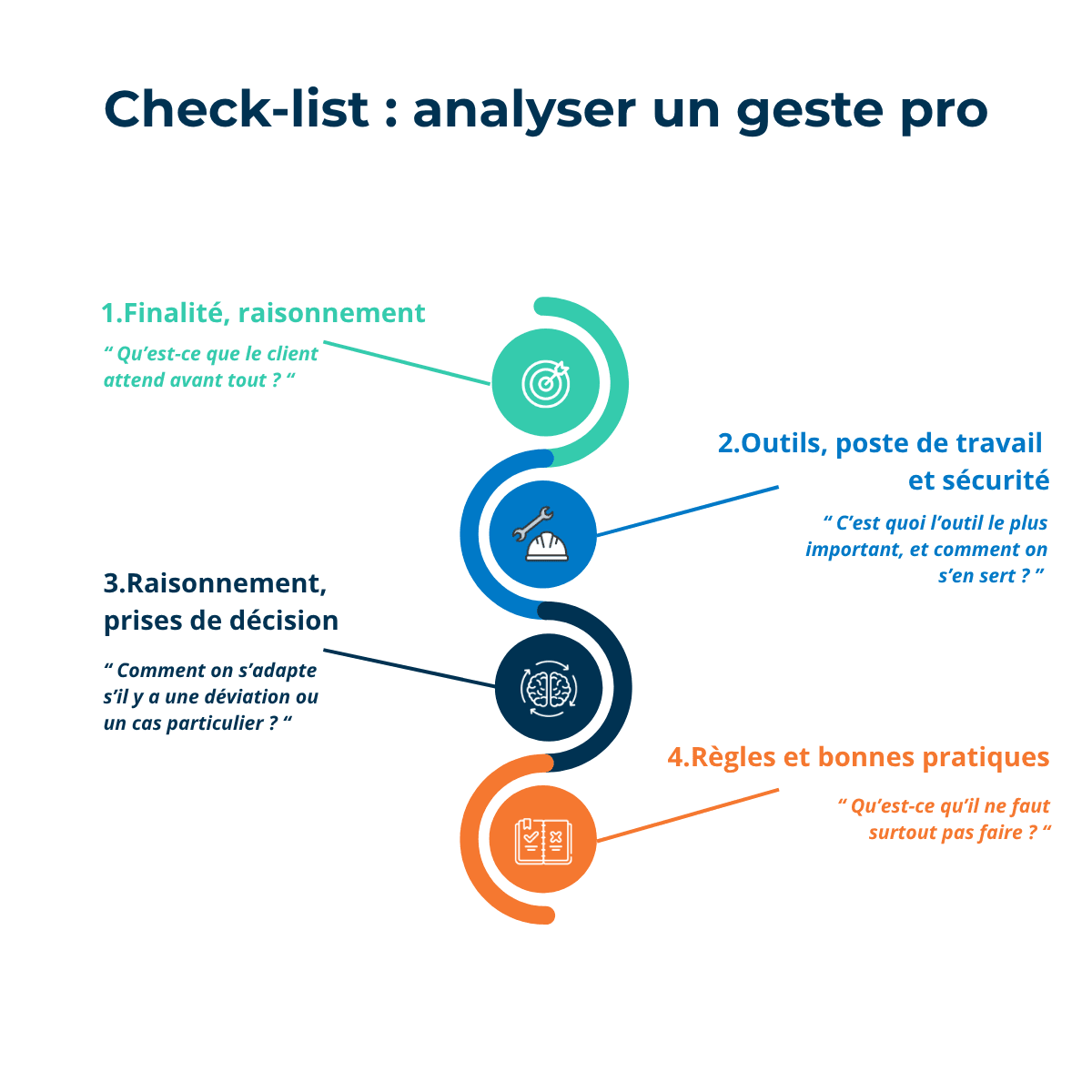
1.The analysis checklist:
2.Simple (and human) indicators:
- Gaps between prescribed and real trade-skills (observations, videos, interviews).
- Rework rate / corrections (reworked parts, corrected entries).
- Feedbacks of fatigue, of lost meaning, of pride restored.
- Nombre d’improvement ideas from the field (proof that the trade-skill is thought through).
3.Ritualise the visibility of the trade-skill
- « 5 minutes geste ” in the daily briefing: everyone shares a trade-skill tip.
- Post-it “what I never say when I do this” on the team board.
- Cross video reviews, or annotated screenshots.
And what about digital in all this?
Augmented reality to visualise the ideal trajectory, motion capture, microlearning, 3D simulations, internal forums… Yes, digital can help show the invisible. On one condition: do not crush the singularity and the situation. A tutorial video does not explain the particular vibrations of a tired machine; an ERP tutorial does not reproduce the pressure of a quarterly close.
-> Use digital as a magnifying glass, not as a mould.
Conclusion : rendre visible, partager, respecter
The professional trade-skill is the soul of the trade in motion. Making it visible means:
- Value the embodied intelligence of operators and managers.
- Improve quality without “policing”, safety without patronising.
- Transfer by means other than forgotten PowerPoints.
So the next time you see a colleague “doing something their way”, instead of saying “do it as in the procedure”, ask them: “Can you show me how you you do it? And tell me what you look at, what you sense, what you pay attention to? ”
There is every chance that behind this small movement, you will discover a larger meaning.
The end… but only on paper. In the field, it starts now.